
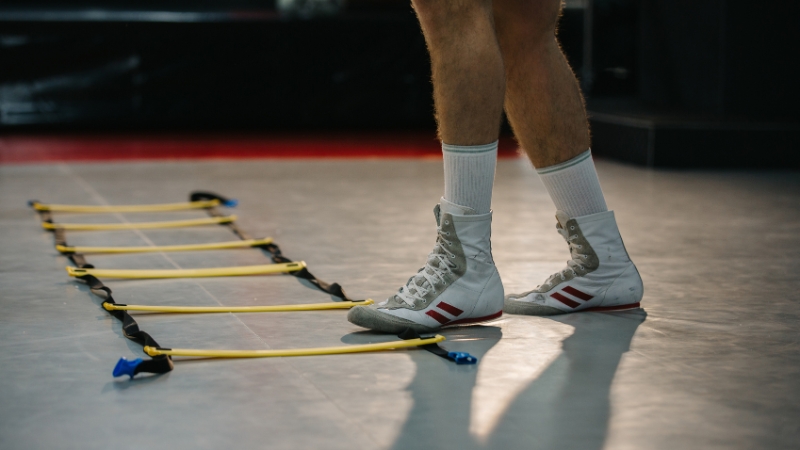
When most people start boxing, they want to learn combinations. They want to throw hooks, they want to look like they know what they’re doing on the heavy bag.
That’s fine, that’s how everyone starts. But pretty quickly, usually after the first time someone in sparring makes them look completely lost, they start to understand that the punches aren’t really the problem.
The movement is the problem.
Footwork is the part of boxing that doesn’t look exciting on highlight reels, but it’s the thing that makes every other part of boxing work. Your power comes from your legs. Your defense comes from your legs.
Your ability to get in range, land something, and get back out before your opponent can respond, all legs.
If your footwork is bad, you’re going to be a puncher who stands in front of people and trades. That works until it doesn’t, and when it stops working, it stops working badly.
The good news is that footwork is trainable. It’s not something you either have or don’t. It’s a skill, and like any skill, you build it through repetition until it stops being something you think about and just becomes how you move.
Get Your Stance Sorted First

Everything starts from your stance, so before any drills make sense, you need to know what you’re working from.
If you’re orthodox (right-handed), your left foot goes forward. Feet about shoulder-width apart, knees slightly bent — not stiff, not squatting, just relaxed.
Your weight should be pretty even across both feet. Rear heel very slightly raised, so you’re on the ball of that foot. Hips turned a little sideways, not square to whoever you’re facing.
That’s basically it. It sounds simple, but most beginners either stand too narrow, too wide, or too square. Check yourself in a mirror a few times before you start moving.
Body Part
What It Should Look Like
Feet
Shoulder-width, left foot forward (orthodox)
Knees
Slightly bent, never locked
Weight
Even — 50/50 on both feet
Rear heel
Slightly up off the floor
Hips
Angled sideways, not facing straight ahead
Lead shoulder
A touch raised to cover your chin
The Main Movement Rule
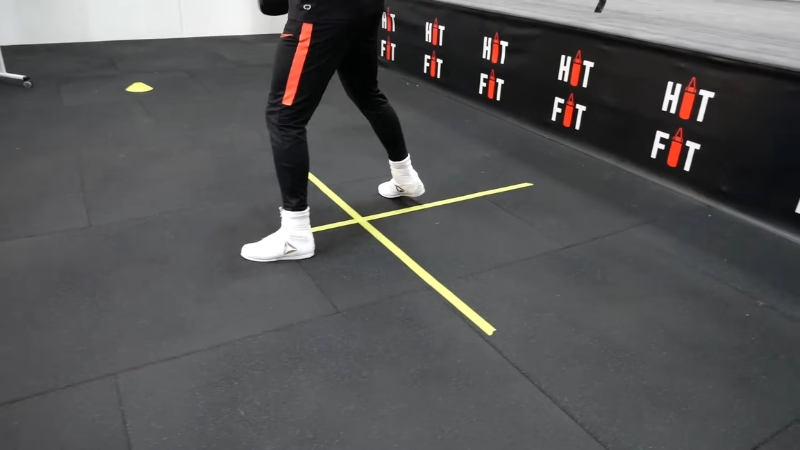
Before any specific drill, there’s one rule that underlies all of it. Learn this, and the drills will make sense. Ignore it, and you’ll develop habits that are hard to undo.
The foot closest to the direction you’re going moves first. The other foot follows to restore your stance width. Your feet never cross. Your feet never come fully together.
That’s it. That’s the whole principle.
Moving forward: left foot steps forward, right foot slides forward to restore the gap. Moving backward: right foot steps back, left foot slides back. Moving right: right foot steps right, left foot slides right.
Moving left: left foot steps left, right foot slides left.
The reason you never cross your feet is balance. The moment your feet cross, you have no stable base. You can’t punch, you can’t change direction, and if someone pushes you or catches you with anything, you go down.
Watch beginners in sparring, and you’ll see them crossing their feet constantly without even realising it — and you’ll see them stumbling and getting caught because of it.
The reason your feet never fully come together is the same — you lose your base for a split second, which is long enough to matter.
Drill this movement principle until you genuinely don’t have to think about it anymore. Everything else builds on top of it.
The Drills
Drill 1: Basic Step-and-Slide
What it is: Pure practice of the fundamental movement in all four directions.
How to do it: Find a line on the floor or put down a strip of tape. Get into your stance on one side of it. Step forward across the line with your lead foot, slide your rear foot up, then reverse it, rear foot steps back, lead foot follows.
Just go back and forth along the line. Then practice the same thing laterally. Three steps right, three steps left.
Focus completely on keeping your stance width consistent throughout. Your feet should never be closer together than shoulder-width and never cross over each other. Stay on the balls of your feet.
Keep your knees soft.
Go slow. Genuinely slow. A lot of people rush through footwork drills because slow feels like they’re not working hard. But slow is where you actually build the pattern.
Your brain needs repetition of the correct movement, and if you’re going too fast to do it correctly, you’re just drilling the wrong thing faster.
Common issues: Feet coming together in the middle of the movement. Flat feet, heels dropping down. The stance is getting narrower over time as fatigue sets in. Head bobbing up and down instead of staying level.
Duration: 3 rounds of 2 minutes. Rest 60 seconds between rounds.
Drill 2: Forward and Backward Lines

What it is: Training quick, smooth direction changes without the hesitation most beginners have.
How to do it: Put two strips of tape on the floor parallel to each other, about three to four feet apart. Start between them in your stance. Move forward until your lead foot crosses the first line, then immediately move backward until your rear foot crosses the second line. Keep going without stopping or pausing at either end. Continuous motion.
The point of this drill is specifically about the transition. Watch beginners do it, and there’s almost always a little pause; they slow down, rock slightly, then start moving the other direction.
That pause is a habit from normal life, where stopping before changing direction is totally fine. In boxing, that pause is when you get hit. The drill conditions you to make the weight transfer and direction change smooth and immediate.
After a few sessions, add a little urgency to it, move at maybe 70% pace, still controlled but with some intention behind it. You’re not sprinting, but you’re moving like someone who has somewhere to be.
Duration: 4 sets of 90 seconds. Rest 45 seconds between sets.
Drill 3: Lateral Shuffle
View this post on Instagram
What it is: Building comfortable, controlled side-to-side movement.
How to do it: From your stance, take three clean step-and-slide steps to your right, then three back to your left. Keep going back and forth. The focus is on keeping your stance width constant throughout; your feet should never come within less than shoulder-width of each other.
Your head should stay at roughly the same height, not rising and falling with each step.
Lateral movement is important for a few specific reasons. Moving to your right (as an orthodox fighter) takes you away from your opponent’s right hand, which is their power hand.
Moving to your left puts you in a better position to throw your own right hand. Just knowing this starts to make footwork feel purposeful rather than just exercise.
The lateral shuffle also exposes a really common problem: most beginners have a strong direction and a weak direction. They’ll shuffle right fairly smoothly but shuffle left awkwardly, or vice versa. Pay attention to this and spend extra time on your weaker direction.
Duration: 3 rounds of 2 minutes.
Drill 4: Box Pattern Footwork
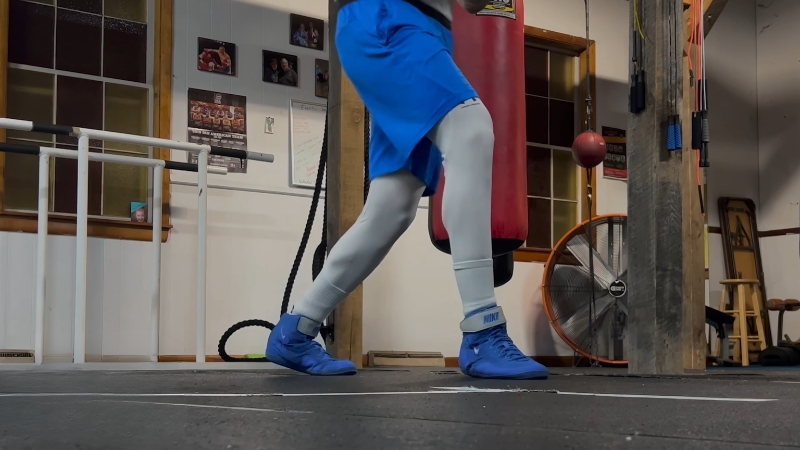
What it is: Linking all four directions together in a continuous pattern.
How to do it: Use tape to make a square on the floor. Each side should be roughly four feet. Get into your stance at one corner. Move forward to the corner ahead of you, then right to the next corner, then backward, then left back to where you started.
Go around the whole box. Then reverse direction. Keep doing laps in both directions.
This is where it starts to click for most people, because you’re not just moving in one direction and reversing, you’re transitioning between different movements. Forward into lateral into backward into lateral.
Each transition requires a small reset and a change in which foot leads the movement. At first, it feels choppy. That’s fine. After enough reps, the transitions start to smooth out.
Once you can go around the box cleanly without thinking about it, start adding punches. Throw a single jab every time you arrive at a corner. Then a jab-cross. Then a combination of your choice.
The rule is always: feet first, punch second. You arrive at the corner, get your stance, then throw. Don’t throw while you’re still moving into position.
Duration: 3 rounds of 3 minutes.
Drill 5: The Pivot
@dtbxing How to pivot in a fight and when to use it👊🏻🔥 #boxing #boxingtechnique #fighttips #selfdefence #boxeo #fyp #foryou ♬ original sound – dtbxing
What it is: Learning to change your angle cleanly without losing your base.
Why it matters: The pivot is something beginners don’t usually prioritise until the first time they’re stuck in a corner in sparring and have absolutely no idea how to get out.
At that point, they either walk straight into their opponent or clinch. Neither is ideal. The pivot is the right answer, and it’s not hard; it just needs to be drilled so it’s available to you when you need it.
How to do it: From your stance, plant your lead foot firmly on the floor. Using your lead foot as a pivot point, swing your rear foot around about 90 degrees.
Your lead foot rotates in place, your rear foot sweeps around, and you end up facing a new direction entirely. You should be in a solid stance at the end of it, weight balanced, ready to move or throw.
Practice it going both directions, pivoting clockwise and counter-clockwise. Then practice it coming out of movement: shuffle forward three steps, then pivot. Shuffle laterally, then pivot.
The goal eventually is for the pivot to feel like a natural option within your movement, not a separate thing you have to think about.
When you’re more comfortable, try this: get close to a wall, put your back near it, then pivot out. This simulates the corner situation and gives you a reference point for how much room you actually need to execute it.
Duration: 3 rounds of 2 minutes.
Drill 6: Agility Ladder
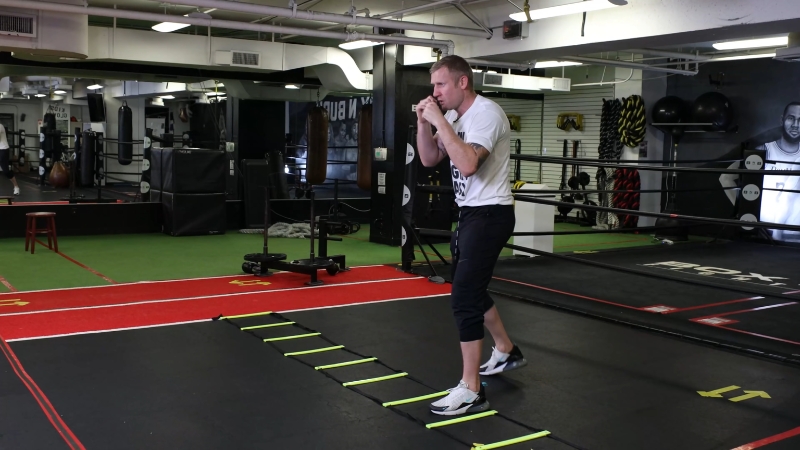
What it is: Building foot speed and coordination independent of boxing-specific patterns.
Equipment: An agility ladder, or tape on the floor, making a ladder of boxes, each about 18 inches square.
How to do it: Run through the ladder in different patterns. Basic two-in-one-out: both feet step into each box, then one foot steps out to the side before moving to the next. Single foot in each box, moving as fast as you can.
Ickey shuffle: step in with your left foot, step in with your right foot, step out to the right with your right foot, then continue forward, left in, right in, out left. That one takes a few sessions to get smooth.
The agility ladder doesn’t directly replicate boxing movement, but what it trains is your feet moving quickly and independently of each other. It also builds calf and ankle strength and conditions your feet to stay light and quick under fatigue.
Most people who do ladder work regularly notice that their feet just feel faster in general, and that does carry over into the gym.
The key is to actually go fast through it, not recklessly, but with some pace. Slow ladder work doesn’t do much. You want your feet moving quickly enough that you have to concentrate to stay accurate.
Duration: 5 sets of 1 minute, different patterns each set.
Drill 7: Shadow Boxing with Intentional Footwork
@dtbxing 🔟 shadow boxing methods and techniques to improve your skillset #boxing #boxeo #boxingtechnique #selfdefense #fighttips #fyp #foryou ♬ som original – ᴄᴇᴊᴏᴛᴀ sᴏɴɢs
What it is: Combining everything, movement, stance, balance, with actual boxing.
This is where it all comes together, and it’s also where most people reveal that their footwork has holes in it. Because when you add punches into the equation, your brain gets busy thinking about the hands, and the feet start doing whatever they want.
How to do it: Set a round going and make one rule for yourself: you are not allowed to throw a punch without first taking a movement step. Even just one step. Move forward and throw a jab.
Shuffle right and throw a cross. Pivot and throw a hook. The movement comes first, the punch comes second.
This feels unnatural at first because most beginners throw punches from where they’re standing, then maybe move afterward. Flipping it, move first, then throw, is the correct sequence. You’re getting into position to throw, throwing from a good position, then moving out again.
That’s what experienced fighters do, and it’s why their punches land cleaner with less energy.
Also, work on your exit after combinations. A lot of beginners throw a combination and then just stand there. Every combination should end with movement, a step out, a pivot, a circle.
You threw your shots, now you leave. Don’t give your opponent a stationary target to hit back at.
Duration: 4 rounds of 3 minutes with a minute rest.
Drill 8: Cone Reaction Drill
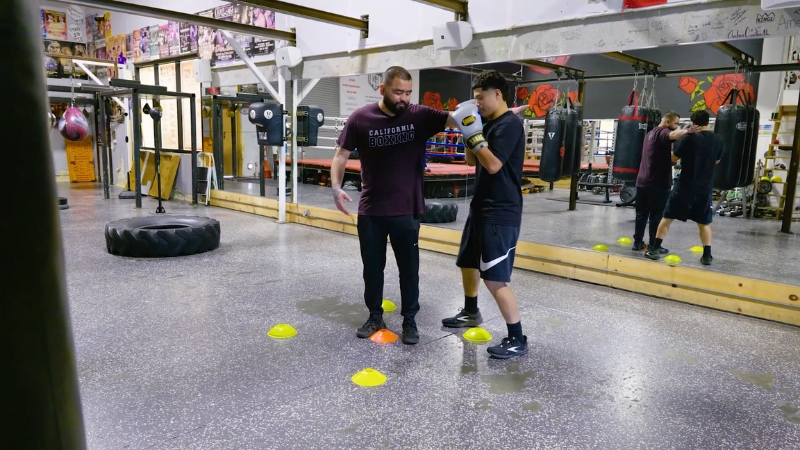
What it is: Reactive footwork training, moving correctly when you don’t know where you’re going.
Equipment: 4 to 6 cones or markers. A partner.
How to do it: Set the cones up in a rough circle or scattered pattern around you, each about three to four feet away. Your partner points to a cone. You move to it using correct footwork, no running, no crossing feet, touch it, and get back to center.
Your partner points to the next one. They vary the timing, sometimes giving you a second, sometimes pointing to the next one almost immediately.
The whole point of this drill is that every other footwork drill lets you know what’s coming. You know you’re going left because you’re doing the lateral shuffle. You know you’re going around the box because you’re doing the box pattern.
This drill takes that predictability away. You have to move correctly on instinct, which is actually what sparring demands.
As you get better at it, your partner can start calling combinations of cones, “right, left, back, forward” in quick succession. You just keep moving between them as fast as you can while staying in a good stance throughout.
Duration: 3 sets of 2 minutes.
Mistakes Everyone Makes
Mistake
Why It Happens
Fix
Crossing the feet
Moving too fast before the pattern is automatic
Slow it way down. Do it half speed until it’s muscle memory
Going flat-footed
Tired calves, not used to staying on the balls of feet
Calf raises, and actively think “light feet” before each round
Bouncing too much
Copying what they see on TV
Keep your head level — if it’s bobbing up and down, your footwork is too bouncy
Moving both feet at once
Feels faster, but kills your balance
Step-and-slide drills, slow and deliberate, every session
Stance width falling apart when moving
Feet creep together when going faster
Tape markers on the floor and stay between them
Moving straight back under pressure
Natural instinct when panicking
Lateral and pivot drills train you out of this habit
A Simple 4-Week Plan
Week
Focus
Drills
Time Per Session
Week 1
Stance + basic movement
Step-and-slide, Forward/back lines
20 min
Week 2
Adding lateral movement
Lateral shuffle, Box pattern
25 min
Week 3
Direction changes + pivots
Pivot drill, Ladder, Box with punches
30 min
Week 4
Pulling it all together
Shadow boxing with full movement, Cone drill
30 min
Three sessions a week are enough. Do the footwork at the start of your session, not the end when you’re already tired. And film yourself occasionally — even just your phone propped against the wall.
You’ll see things you can’t feel, and it makes a big difference.
One Last Thing
The first few weeks of footwork drills feel slow and a bit pointless because you’re not hitting anything. You’re just moving around a floor. But that’s genuinely where the skill gets built.
Once it’s automatic — once you’re not thinking about your feet at all — that’s when your boxing starts to actually improve. Everything else gets easier when the movement is sorted. Start there.