
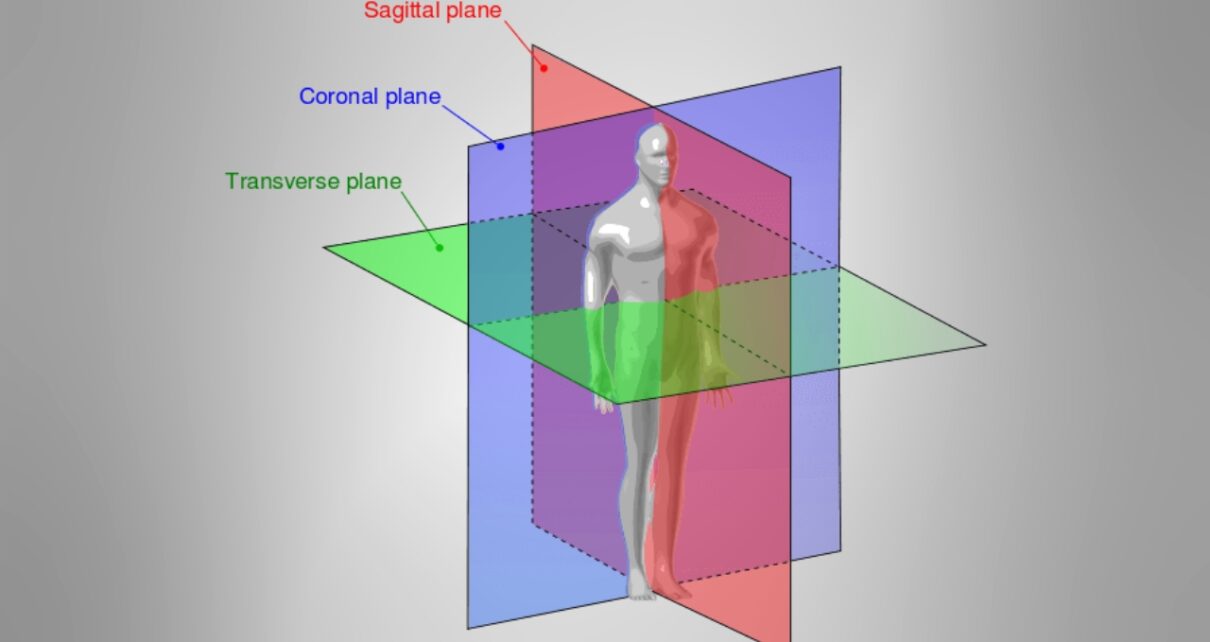
Here’s the truth about planes of movement: the sagittal plane (forward/backward) dominates almost every gym program ever written.
Squats, deadlifts, lunges, curls, presses, all sagittal.
That’s not inherently bad, but if you never train the frontal (side-to-side) and transverse (rotational) planes, you are building strength in a bubble that doesn’t match how your body actually moves in the real world.
Plane 1: The Sagittal Plane
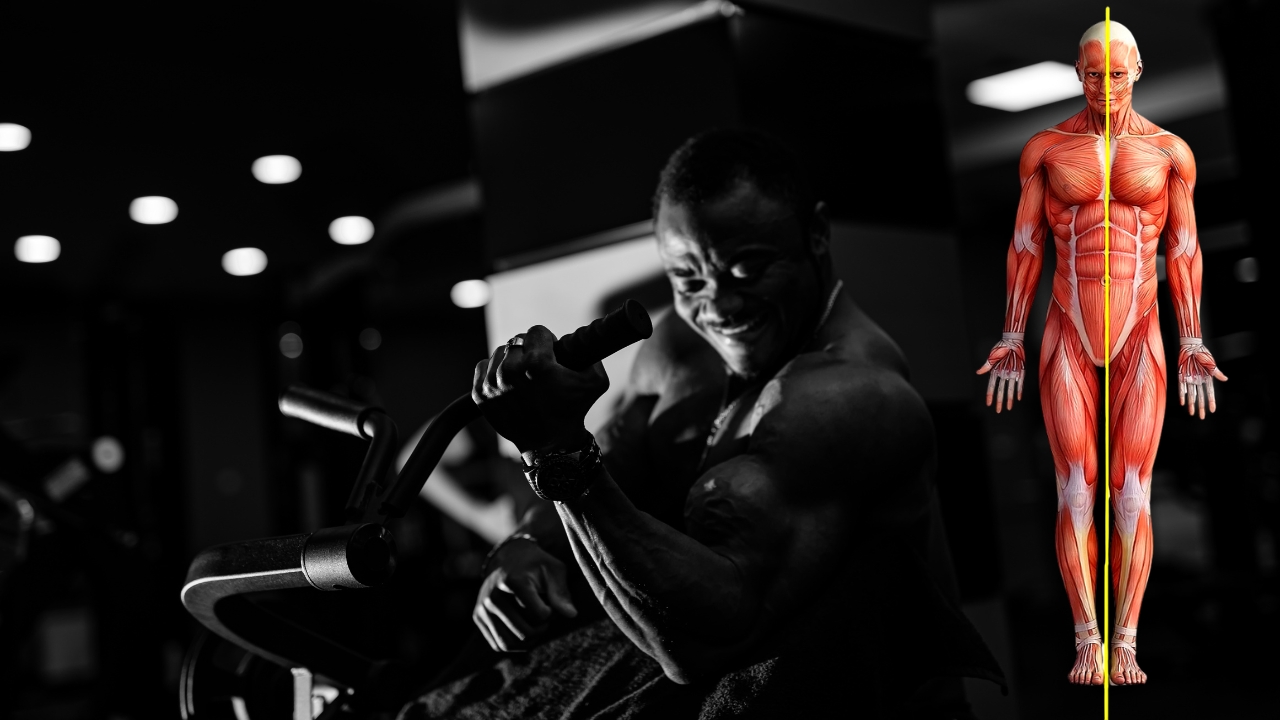
What it is: An imaginary vertical cut that divides your body into left and right halves. Any movement that travels forward and backward, or up and down, parallel to that line, lives in the sagittal plane.
Joint actions involved: Flexion, extension, dorsiflexion, and plantar flexion. These are the bread-and-butter joint movements of almost every compound exercise.
Everyday examples: Walking, running, climbing stairs, sitting down and standing up, reaching forward for something.
Exercise examples: Squats, deadlifts, lunges, RDLs, pull-ups, rows, bench press, bicep curls, calf raises, and forward jumps.
All of the “Big Six Movement Patterns”- squat, hinge, lunge, push, pull, and carry- occur within the sagittal plane, meaning they involve up-and-down or forward-and-backward motion. U.S. News & World report that this is why the sagittal plane dominates most training programs.
These movements are the most mechanically efficient for building muscle and strength, and they reflect the most common direction humans move throughout the day.
The catch? All too often, exercise routines focus far too much on the sagittal plane. While running, squats, curls, and press-downs are fantastic muscle and strength-building exercises, they are not the ones that build three-dimensional movement efficiency and help prevent injury, according to The Company of Biologists.
If sagittal plane work is all you do, you’re essentially training your body to be strong in one direction while leaving the joints and muscles that stabilize lateral and rotational forces underdeveloped, which is exactly where a lot of “random” injuries happen.
Plane 2: The Frontal Plane (Coronal Plane)
View this post on Instagram
What it is: An imaginary vertical cut that divides your body into front (anterior) and back (posterior) halves. Also known as the coronal plane, this imaginary vertical plane divides the front and back halves of the body, slicing down through both shoulders. Lateral movement, side-to-side motions, occurs on the frontal plane.
Joint actions involved: Abduction (moving a limb away from the body’s midline), adduction (moving toward the midline), lateral flexion of the spine, and elevation/depression of the shoulder blades.
Everyday examples: Stepping sideways to let someone pass, reaching an arm out to the side, loading groceries into a car, that sideways dodge you do when someone walks at you on the street.
Exercise examples: Lateral lunges, side shuffles, lateral raises, side-lying leg raises, lateral band walks, Cossack squats, side-to-side box jumps, suitcase carries.
The frontal plane is the most neglected of the three in standard gym programming, and it shows. The muscles that make up the frontal plane keep humans from falling over. The frontal plane includes everything that runs laterally on the body, so this can help us prevent falling to one side completely.
University of New Mexico research shows that hip abductors, gluteus medius, obliques, adductors, and the lateral stabilizers of the ankle and knee are all primarily frontal plane structures. When they’re undertrained, the body compensates, usually badly, the moment it needs lateral stability.
This has real injury consequences. The knee adduction moment (KAM), a frontal plane measure, is one of the strongest predictors of medial knee osteoarthritis onset and progression.
And from a sports medicine perspective, research published in the British Journal of Sports Medicine found that ACL injury prevention programs that focus only on sagittal plane landing mechanics are likely to be less effective because frontal and transverse plane loading mechanisms are also significant contributors to non-contact ACL tears. You can’t squat your way out of a knee that has no lateral stability.
For athletes, frontal plane strength is often the difference between a good change-of-direction movement and a pulled groin or rolled ankle. Any sport requiring lateral cutting, such as basketball, football, tennis, and soccer, runs primarily on frontal plane capacity.
Plane 3: The Transverse Plane (Axial Plane)
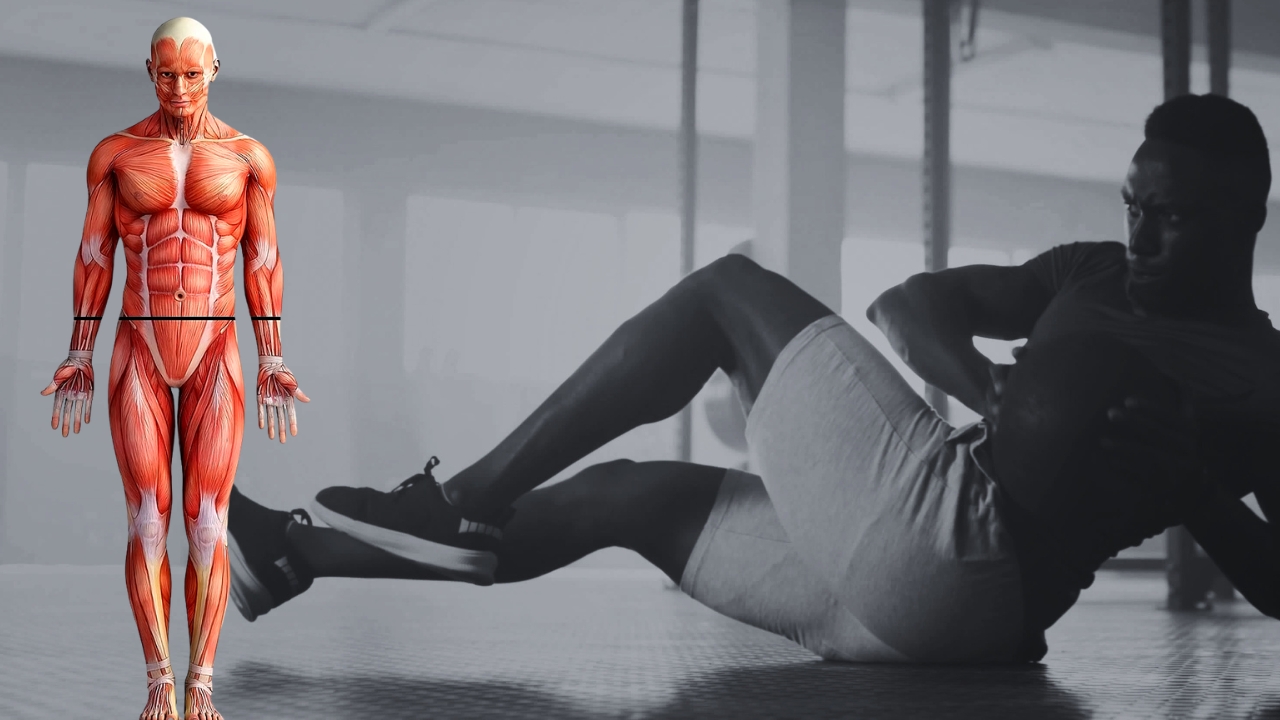
What it is: An imaginary horizontal cut that divides your body into upper (superior) and lower (inferior) halves at roughly the waistline. Rotational movement occurs in the transverse plane.
Joint actions involved: Internal and external rotation of the limbs and spine, horizontal abduction, horizontal adduction, pronation, and supination.
Everyday examples: Turning your head to look over your shoulder, twisting to reach the back seat of a car, throwing a ball, swinging a golf club, opening a heavy door from the side.
Exercise examples: Russian twists, cable woodchops, medicine ball rotational throws, landmine rotations, Pallof press, hip internal/external rotation work, seated or standing torso rotations, push-ups (yes, the shoulder joint moves in the transverse plane during a push-up).
This last point surprises a lot of people. When the arms or legs are held at 90 degrees to the body and move toward or away from the center, it becomes transverse plane movement. This type of movement is seen in exercises like the bench press, push-ups, chest and back flys, and seated hip adduction/abduction machines, termed horizontal adduction and abduction.
So even though exercises like push-ups or the seated hip adduction machine might seem like sagittal or frontal plane movements, they are actually transverse plane movements due to the rotation that happens within either the shoulder or hip joints.
The transverse plane is the one where most exercise injuries actually occur. According to NASM, exercise injuries most often occur during transverse (rotational) movements. This makes sense: rotational forces are complex, involve more joints simultaneously, and are rarely trained with the same consistency as forward/backward movements.
When an untrained rotational demand suddenly appears, slipping on ice, reaching behind you while carrying something, or a reactive cut in a sport, the structures involved simply aren’t prepared for it.
The athletic performance case for transverse plane training is equally compelling. One study found that proficient golfers have greater transverse plane flexibility, which accounted for 48% of ball speed variability and 45% of total distance variability.
Researchers concluded that developing transverse plane flexibility can help golfers optimize their performance. The same principle applies across throwing sports, racket sports, combat sports, and any activity that involves rotation at the hips or thoracic spine.
Why Most Training Programs Get This Wrong

The problem isn’t that people train the sagittal plane; it’s that they train only the sagittal plane and assume they’re covered. If one plane is missed, it would be like working the biceps without also working the triceps; a muscle imbalance can develop.
Skipping a plane of motion during exercise can also negatively impact injury risk. Plus, we use all three planes of motion in our everyday movements.
As spine researcher Dr. Stuart McGill has noted, “I see too many athletes that are getting hurt in the gym and their patterns are looking more like that of lifters, so it’s not their sport, it is their training causing injuries. Sagittal plane heavy strength training has limited benefits for rotational athletes.”
Running is a perfect illustration of this. Most people think of it as purely sagittal; you move forward. But biomechanically, efficient running simultaneously involves frontal plane hip abduction for single-leg stability, and transverse plane thoracic rotation with every arm swing.
Train only sagittal, and you’ll become a better runner in a straight line with progressively worse lateral stability and rotational power, which is exactly how overuse injuries like IT band syndrome and hip impingement develop.
How to Actually Train All Three Planes
The good news is that correcting a sagittal-dominant program doesn’t require reinventing your training. It mostly requires adding targeted exercises and using some multiplanar substitutions.
Here’s how to think about it:
Audit your current program first. Go through your last week of training and label each exercise, sagittal, frontal, or transverse. Most people discover they have 8–10 sagittal movements, 1–2 frontal (usually a lateral raise counts), and zero genuine transverse. That asymmetry tells you exactly what to fix.
Add lateral work to your lower body sessions. The lateral lunge and its variations (Cossack squat, lateral step-up, lateral band walk) are the single highest-return additions for most people. They hit the gluteus medius, hip adductors, and lateral ankle stabilizers, all typically underdeveloped. One or two sets as a warm-up movement go a long way.
Build rotational core work into every session. Not crunches, rotation. Pallof presses, cable woodchops, medicine ball rotational throws, and landmine exercises are the tools here. The goal is to develop what’s called “anti-rotation” strength (resisting unwanted twist) alongside actual rotational power.
Use single-arm and single-leg variations. A simple way to make an exercise multiplanar is to do a single-arm or single-leg version. When the load is only on one side, your body has to fight to stay in position and keep from rotating or bending toward the loaded side.
For example, a single-arm shoulder press becomes both a sagittal and frontal planar exercise as the core muscles work to keep the body upright.
Incorporate combination movements. A lunge with rotation hits sagittal and transverse simultaneously. A lateral lunge to balance reaches into frontal and requires transverse stability. A Turkish get-up crosses all three. These compound multiplanar movements are the most time-efficient way to build well-rounded movement capacity.
The Bottom Line
@muscleandmotionVisualizing movement shouldn’t be a guessing game. 📐🦾 We all learn about the 3 Planes of Motion in theory, but seeing them in real movement makes learning clearer, easier, and far more intuitive, without unnecessary memorization. This short clip gives you a sneak peek at how the Sagittal, Frontal, and Transverse planes actually divide the body and guide real movement. Want the full 3D video with explanations? Download our apps → Go to the main menu → Theory → Anatomical Terminology → Planes of Movement (The full video is available in all our apps) Head to our bio to learn more🔗♬ סאונד מקורי – Muscle & Motion
The three planes of movement, sagittal (forward/back), frontal (side-to-side), and transverse (rotation), represent the full three-dimensional space your body operates in every single day.
A well-structured full-body mobility routine for beginners should include movements in all three planes to build balanced strength and coordination from the start.
Most training programs heavily favor the sagittal plane because that’s where the most popular exercises live and where the most visible muscle development happens. That’s not wrong, but it is incomplete.
The frontal plane stabilizes your hips, knees, and spine against lateral forces. The transverse plane drives athletic rotation, protects your joints from the kind of reactive twists that cause real-world injuries, and directly impacts performance in almost every sport.